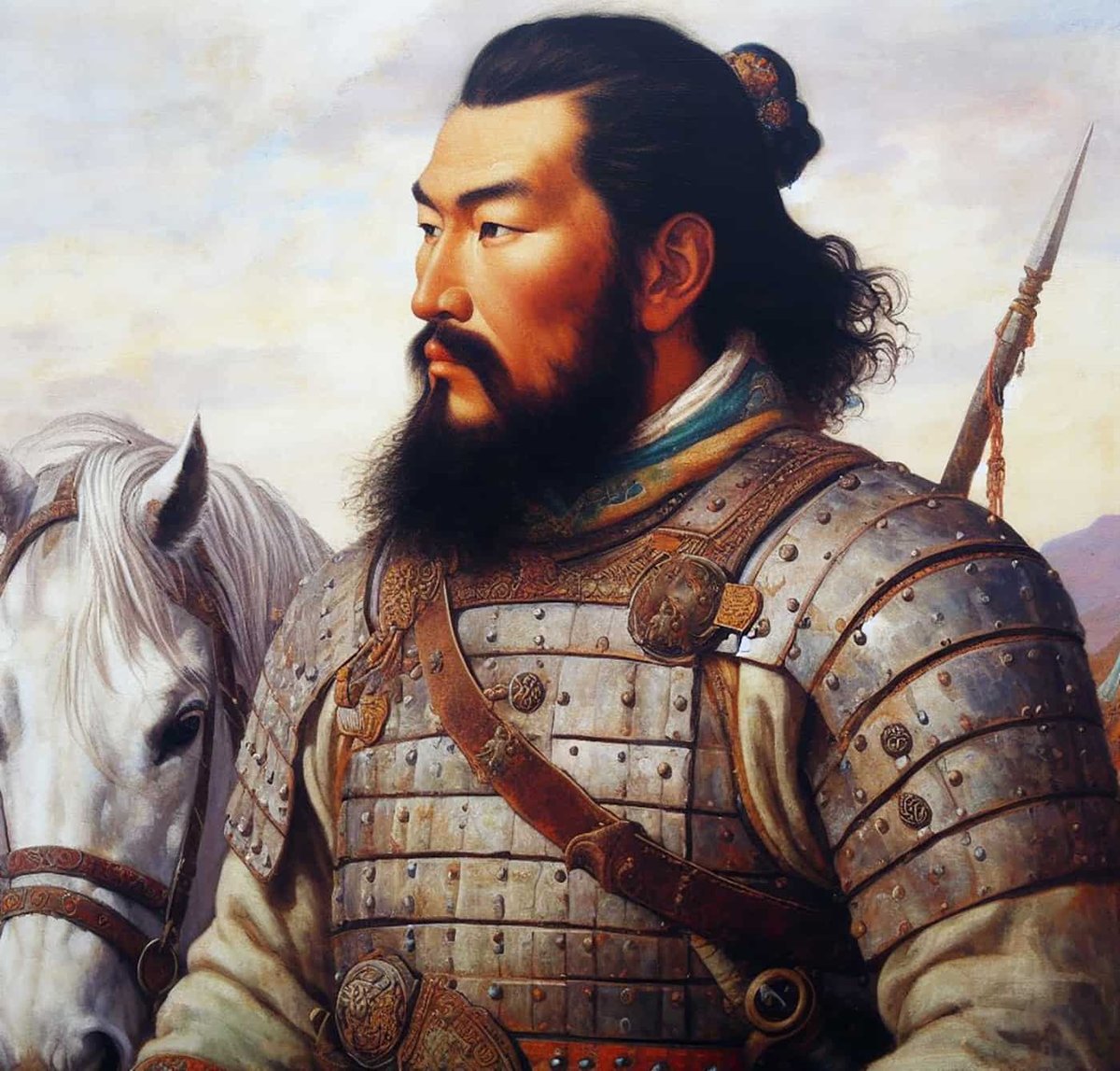
When Genghis Khan, the legendary founder of the Mongol Empire, drew his last breath in 1227, he left behind an empire of unprecedented scale, stretching from the Pacific to the Caspian Sea. Far from collapsing, this colossal entity continued to expand and evolve, thanks in large part to his Genghis Khan's Four Main Sons: Roles, Conquests, and Legacies. These four men—Jochi, Chagatai, Ögedei, and Töle—were not just heirs to a throne, but the designated architects of its future, tasked with transforming a unified war machine into a sustainable, sprawling imperium.
Their father had laid the groundwork with the Yassa, a foundational code of laws, and an innovative system of territorial division, or ulus, based on traditional nomadic 'apanage'. This wasn't merely about handing out land; it was a calculated move to ensure stability and unity under a single Great Khan, setting the stage for his sons to etch their own indelible marks on history.
At a Glance: The Cornerstones of the Mongol Empire
- Jochi: The eldest, whose legitimacy was often questioned, was assigned the western steppes. Though he died before his father, his allocation became the mighty Golden Horde, with his son Batu leading devastating campaigns into Eastern Europe and Russia. His legacy is tied to significant Mongol influence in the West.
- Chagatai: The second son, a staunch traditionalist and enforcer of the Yassa. He ruled Central Asia, his Khanate becoming a vital nexus for trade along the Silk Road. His rigorous adherence to Mongol law shaped a unique cultural blend of Mongol, Turkic, and Persian traditions.
- Ögedei: The third son, chosen by Genghis Khan himself as successor and confirmed as the second Great Khan. His reign marked the empire's greatest territorial expansion, the subjugation of the Jin Dynasty, and critical administrative reforms, including the establishment of Karakorum as the capital.
- Töle: The youngest, a brilliant military commander who inherited the Mongol heartland and the primary army. Though never Great Khan, his lineage—particularly his sons Möngke and Kublai Khan—would dominate later imperial succession, ultimately founding the Yuan Dynasty and profoundly influencing the empire's ultimate trajectory.
The Blueprint for an Empire's Future: Genghis Khan's Vision
Imagine forging an empire of such immense proportions that it dwarfs anything seen before. Genghis Khan didn't just conquer; he strategized for posterity. His vision for succession and governance was revolutionary for a nomadic people. He understood that unity, while hard-won, could easily fracture without a clear system.
This system revolved around a few key tenets: the Yassa, a comprehensive legal code intended to bind the empire together; and the division of conquered lands into ulus, or territories, distributed among his sons. This traditional nomadic custom of 'apanage' wasn't about absolute independence but about creating manageable administrative units, each contributing to the greater whole, all ultimately loyal to the Great Khan. His principal wife, Börte, bore these four sons, securing a direct lineage that would govern the known world for centuries. Their ability to uphold this complex legacy would determine whether Genghis Khan's dream would flourish or crumble. You can learn more about the broader family dynamics and other influential figures in the Mongol Empire through articles like Genghis Khans Children.
Jochi: The Eldest Son and the Western Frontier's Founding Father
Jochi, the eldest of Genghis Khan’s sons, was a figure shadowed by both military success and personal controversy. His birth, occurring shortly after Börte's brief captivity by a rival tribe, led to persistent questions about his legitimacy. While Genghis Khan always recognized Jochi as his son, this cloud of doubt often fueled tensions within the family, particularly with Chagatai. Despite this, Jochi proved himself a capable military commander, leading key campaigns in the early expansion of the Mongol Empire, particularly towards the west.
The Shadow of Doubt and the Western Ulus
The legitimacy question, while never officially denying Jochi his status as a son of Genghis Khan, was a persistent undercurrent that impacted his political standing among his brothers. Nevertheless, Genghis Khan assigned him the vast western steppes, territories stretching from the Irtysh River to the Volga, forming the Ulus of Jochi. This expansive domain was a frontier, a land ripe for further conquest and integration into the burgeoning empire. Jochi, however, passed away in 1227, the same year as his father, leaving his immense inheritance to his own sons.
Batu's Conquests: Forging the Golden Horde
It was Jochi's son, Batu Khan, who truly cemented his father's legacy by establishing what would become the formidable Golden Horde. Beginning in the 1230s, Batu spearheaded a series of devastating military campaigns that swept through Eastern Europe and Russia. He conquered the Kievan Rus' principalities, subjected vast swathes of what is now Ukraine, Russia, Poland, and Hungary, reaching as far as the Adriatic Sea. These campaigns were not mere raids; they were systematic conquests that integrated these regions into the Mongol sphere of influence, exacting tribute and establishing a long-lasting Mongol hegemony.
A Lasting Western Influence
The Golden Horde, named for the golden color of Batu's tent, became a powerful and enduring Mongol successor state. For over two centuries, it exerted significant control over Russian principalities, profoundly shaping Russian political development, military organization, and even cultural identity. Its influence extended across the Eurasian steppes, connecting East and West through trade and cultural exchange, albeit often through the lens of conquest and subjugation. Jochi's initial allocation, brought to full power by his descendants, ensured that the Mongol Empire's reach extended deep into Europe, leaving an undeniable and complex mark on the continent's history.
Chagatai: The Guardian of Tradition in Central Asia
Chagatai, the second son, was a man of principles—unyielding, strict, and deeply committed to his father's vision of law and order. He was the designated guardian of the Yassa, Genghis Khan’s fundamental legal code, and his dedication to preserving Mongol customs and laws defined his rule.
A Strict Adherent to the Yassa
While other parts of the empire might gradually adapt or soften their interpretation of Mongol traditions, Chagatai ensured that the Yassa remained the supreme law in his domain. His rigorous enforcement of these laws impacted everything from military discipline to social conduct, creating a region that prided itself on upholding the purity of Mongol heritage. This strictness, though sometimes unpopular, served a crucial purpose: it provided a stable framework for governance in a region undergoing massive transformation.
The Heart of the Silk Road: The Chagatai Khanate
Chagatai's assigned ulus encompassed Central Asia, a strategically vital region encompassing modern-day Uzbekistan, Kyrgyzstan, and parts of Kazakhstan. This area was not just geographically expansive; it was the historic crossroads of civilizations, traversed by the ancient Silk Road. Under Chagatai's rule, his Khanate became an essential link for these crucial trade routes, facilitating the flow of goods, ideas, and cultures between East and West. The stability provided by his strict legal system, ironically, fostered an environment where trade could thrive, bolstering the empire's economic backbone.
A Melting Pot of Cultures and Laws
The Chagatai Khanate, while steeped in Mongol law, was never isolated. Its central location meant it constantly interacted with a diverse array of peoples, including Turkic tribes, Persians, and various nomadic groups. This constant interaction led to a unique cultural synthesis, where Mongol administrative practices, Turkic languages, and Persian artistic and intellectual traditions began to intertwine. Chagatai's legacy, therefore, isn't just about preserving the Yassa; it's about how that preservation occurred within a vibrant, multicultural context, leading to a distinct Central Asian identity that endured for centuries. His domain became a testament to the fact that even strict legal adherence could coexist with and, in some ways, even facilitate cultural blending.
Ögedei: The Great Khan Who Cemented the Empire
If Genghis Khan was the founder, Ögedei, the third son, was the architect who solidified and expanded the edifice. Designated by his father as successor, and later confirmed as the second Great Khan by the kurultai (a great assembly) in 1229, Ögedei’s reign was a pivotal era for the Mongol Empire. He inherited a vast, powerful, but still somewhat nascent state, and transformed it into a truly enduring and administratively sophisticated imperium.
The Chosen Successor and a Vision for Unity
Genghis Khan's choice of Ögedei, despite Jochi being the eldest and Töle a celebrated warrior, was a testament to Ögedei's diplomatic skills, moderate temperament, and perceived ability to maintain unity among his powerful brothers. His confirmation by the kurultai underscored the importance of collective decision-making in the early Mongol state, even as it affirmed the Great Khan’s ultimate authority. Ögedei understood that the empire needed more than just military might; it needed a centralized administration capable of governing its immense territories.
Architect of Expansion and Administration
Ögedei’s reign marked a period of both aggressive expansion and profound internal development, leading the empire to its greatest territorial extent.
- Military Zenith: Under Ögedei's leadership, Mongol armies achieved spectacular successes. The most significant was the complete subjugation of the Jin Dynasty in northern China in 1234, a decades-long conflict that finally brought a major sedentary civilization fully under Mongol control. Concurrently, he launched extensive campaigns into Eastern Europe, devastating Kievan Rus', Hungary, and Poland. These coordinated military efforts demonstrated the unparalleled organization and power of the Mongol war machine.
- Building a Capital: Understanding the need for a fixed administrative center, Ögedei established Karakorum as the empire's permanent capital in modern-day Mongolia. This wasn't merely a camp; it was a planned city, complete with palaces, temples, mosques, and administrative buildings, symbolizing the shift from a purely nomadic lifestyle to a settled imperial power. Karakorum became a hub for diplomacy, trade, and the collection of tribute from across the empire.
- State-Building Innovations: Ögedei implemented crucial administrative reforms to make the empire sustainable. He expanded and refined the Yam, the efficient Mongol postal system, which facilitated rapid communication across vast distances. He also introduced standardized tax systems, moving beyond ad-hoc tributes to a more organized revenue collection, essential for funding the state and its military. These innovations laid the groundwork for a more robust and lasting imperial structure, proving that the Mongols were not just destroyers, but also sophisticated builders of states.
Ögedei's reign was a testament to his ability to balance aggressive expansion with essential internal reforms. He ensured the empire's continued growth while establishing the administrative foundations that would allow it to endure long after his passing.
Töle: The Military Backbone and a Dynasty's Foundation
Töle, the youngest of Genghis Khan’s four main sons, was a force of nature on the battlefield. Known for his extraordinary military prowess, he inherited the Mongol heartland and, crucially, the main body of the Mongol army. While he did not ascend to the position of Great Khan himself, his legacy proved to be the most influential in shaping the empire's later direction through his powerful descendants.
A Master Strategist and Commander
From an early age, Töle distinguished himself as a brilliant military commander. He fought alongside his father in many campaigns, earning a reputation for courage, tactical genius, and ruthless efficiency. His inheritance of the traditional Mongol homelands, including the ancestral pastures and the core fighting force, underscored his importance in the empire's military structure. He was the strong arm, the direct heir to Genghis Khan's martial might.
The Power Behind the Throne, Not On It
Despite his military brilliance and his control over the central army, Töle did not become Great Khan. This decision, primarily stemming from Genghis Khan's explicit designation of Ögedei as his successor, highlights a key aspect of Mongol succession: while military strength was vital, the ability to unite diverse factions and govern wisely was often prioritized for the supreme leadership. Töle's loyalty to his father's wishes and his support for Ögedei's ascension were crucial for maintaining initial unity within the empire, preventing an immediate succession crisis.
A Lineage of Emperors: Töle's Enduring Impact
Töle’s true legacy lay in his sons, who would go on to reshape the course of the Mongol Empire. His son Möngke Khan became the fourth Great Khan, restoring a sense of centralized authority after a period of instability. Even more significantly, Töle’s son Kublai Khan would rise to become the fifth Great Khan, completing the conquest of China and establishing the Yuan Dynasty, a formidable imperial power that governed China for nearly a century. This lineage, the "Töleids," profoundly influenced the Mongol Empire's later direction, including its shift towards a more sedentary, Sinicized form of governance and its eventual fragmentation into distinct successor states. The descendants of Töle would ultimately dominate the emperorship, giving rise to a new imperial vision that looked eastward to China.
Beyond Bloodlines: How the Sons Forged Distinct Khanates
Genghis Khan’s genius lay not only in conquest but in envisioning a framework for his empire's continuation. His sons, each in their own way, took up this monumental task. They transformed his unified war machine into a collection of distinct, albeit initially interconnected, khanates. This wasn't a simple division; it was an organic process where each ulus developed its unique character shaped by the personality of its ruler, the geography of its domain, and the cultures it absorbed.
Jochi’s descendants forged the Golden Horde, looking west and leaving an indelible mark on Russia and Eastern Europe. Chagatai's khanate became a bastion of Mongol tradition and a vital conduit for the Silk Road in Central Asia, a crossroads of Turkic, Persian, and Mongol influences. Ögedei, as Great Khan, expanded the empire to its territorial peak and laid critical administrative foundations from Karakorum, striving for a unified imperial system. And Töle's lineage, through Möngke and Kublai, eventually established the Yuan Dynasty, fundamentally altering the empire's center of gravity and its administrative approach.
Their collective efforts ensured the empire's survival and continued expansion for decades after their father's death. Despite internal rivalries and eventual fragmentation, these sons laid the groundwork for successor states that would influence world history for centuries, shaping trade routes, legal systems, and cultural landscapes across Eurasia.
Common Questions & Enduring Insights
The story of Genghis Khan’s sons is complex, often sparking questions about their relationships, decisions, and impact. Let's tackle a few common ones.
Did the Sons Always Get Along?
Hardly. While Genghis Khan was alive, his immense authority largely kept their rivalries in check. However, deep-seated tensions, particularly concerning Jochi’s legitimacy and the distribution of power and resources, simmered. After Genghis Khan's death and especially following Ögedei's passing, these rivalries intensified, leading to outright conflicts over succession and territory. The empire, though initially unified under a Great Khan, eventually splintered due to these persistent family feuds.
Was the Division of the Empire a Good or Bad Decision?
It was both. The division into ulus was essential for governance. An empire of such vastness simply couldn't be ruled effectively from a single capital without significant devolution of power. This system allowed for localized administration, tailored to the specific needs and cultures of each region. However, it also sowed the seeds of disunity. As the individual khanates grew in power and developed distinct interests, the bonds of family and shared heritage weakened, eventually leading to open warfare between them and the final fragmentation of the empire into independent entities.
How Did They Maintain Mongol Identity in Such Diverse Regions?
The Yassa played a crucial role. Its principles, even if interpreted differently, provided a common legal and moral framework. Military presence, the continuous influx of Mongol warriors, and the establishment of Mongol administrative structures also helped. However, each khanate also saw a degree of cultural assimilation. Over time, the Mongols in the Golden Horde became Turkified, those in the Ilkhanate (Persia, founded by another of Töle's sons) became Persianized, and those in the Yuan Dynasty adopted Chinese customs. While a core Mongol identity persisted, it was often blended with the local cultures they ruled.
What Happened to Their Khanates?
The khanates founded by or inherited by Genghis Khan's sons had long, complex, and distinct histories:
- The Golden Horde (from Jochi’s ulus) dominated parts of Eastern Europe and Russia for over 200 years, eventually weakening and fragmenting into smaller successor states by the 15th century.
- The Chagatai Khanate (Central Asia) endured for several centuries, though it too experienced internal divisions and transformations, eventually giving rise to influential figures like Timur (Tamerlane), who would revive a semblance of a Mongol-Turkic empire.
- The Yuan Dynasty (founded by Töle’s son Kublai Khan in China) ruled for nearly a century before being overthrown by the Ming Dynasty in 1368, but its influence on Chinese governance and culture was profound.
- The Ilkhanate (Persia, founded by Töle’s son Hülagü) merged Mongol, Persian, and Turkic cultures, lasting until the mid-14th century and leaving a significant legacy in art, architecture, and science.
Each khanate, though born from a single imperial vision, forged its own destiny, leaving behind unique legacies that continue to shape the regions they once ruled.
The Unbreakable Legacy: Shaping Modern Asia and Beyond
The story of Genghis Khan's four main sons is far more than a tale of inheritance; it's an epic of state-building, cultural synthesis, and relentless ambition that profoundly shaped the medieval world. From the administrative innovations of Ögedei to the legal steadfastness of Chagatai, the military might of Töle's lineage, and the far-reaching conquests enabled by Jochi's descendants, these brothers were the engines that kept the Mongol Empire not just alive, but thriving and transforming.
They didn't just inherit an empire; they actively engineered its future. Through their roles as administrators, conquerors, and cultural architects, they laid the foundations for successor states that would profoundly influence the political, economic, and cultural landscapes of Asia and Eastern Europe for centuries. Their strategic decisions, their rivalries, and their lasting contributions ensured that the Mongol legacy wasn't just a fleeting moment of conquest, but a monumental, complex, and enduring force in world history. Understanding their individual and collective journeys is essential to grasping the full scope of one of history's most fascinating empires.